Twinz build notebook · Article 0
The street refused to stop at the edge of the screen
In September, all I wanted was to make a little ink figure walk. Two months later, 12,255,926 residents of Île-de-France live out their day in a Paris you can visit from a browser. In between, I built a first city until it became excessive, hit the wall it deserved, and started all over again.
A line of ink
It all started with a tiny wish. On 21 and 22 September 2026, I wanted to generate little ink cartoons with code, in the spirit of Sempé. You know those drawings: an immense boulevard, façades all the way up to the top of the page, and right at the bottom a nobody of a man you can't take your eyes off. That was the gaze I was after, that tenderness for people who don't know they are being watched.
On the evening of the 22nd, a first ten-second shot was rendering its 240 frames. The next day, a one-minute-twenty film held together from start to finish: fourteen shots and a title, The Umbrella. Along the way, I had thrown out 3D heads that clashed with the ink and gone back to traced silhouettes. I picked up a habit there that has never left me: judge by the image, with my own eyes, even when every automated check says everything is fine.
23 September, 6:51 pm
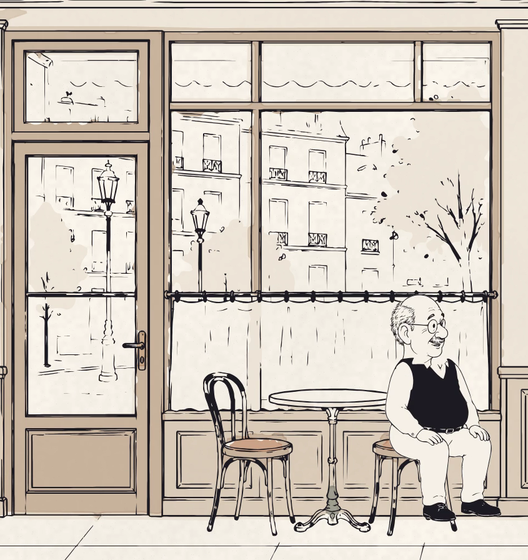
I should have been happy. A film is something you show and play again. It was while playing it again that the unease set in, because it started over exactly the same way. My character would never take a step I hadn't decided, and when he reached the edge of the frame, he went nowhere. Beyond the corner of the screen, there was no next street, and no one waiting for him.
I started staring at that corner. Where did the street lead? Who lived upstairs? My character and his umbrella: was someone somewhere watching for them to come home? The street refused to stop where I had cut it. It wanted to turn, open onto a square, run down to the Seine, and I could feel it would take me much further than I had planned to go.
On 23 September at 6:51 pm, I gave in. I know the minute because it is still written down. Choreographing everyone's moves in advance suddenly amused me far less than another idea, crazy and very simple: a real city, populated by inhabitants who would decide their own day, and where anyone could come for a walk.
Going overboard
At first I handed my inhabitants' decisions to a large language model, one of those programs that write the way we talk. With a handful of characters, it was enchanting. At the scale of a neighbourhood, it was ruinous: even batching forty questions into a single call, one single moment of decision cost 9,136 tokens, those fragments of text you pay for by the unit. I tried a small free model installed on my machine, then personalities, emotions, timetables. My inhabitants became as punctual as clocks, and about as alive. On 1 October, I banned myself from manufacturing realism with schedules written into the code.
Meanwhile, the imaginary city was giving way to the real one. On 26 September, 2,113,627 Parisians counted by Insee each had their own building. On the 29th, the map held 205,022 buildings, sixteen metro lines, fifteen tram lines, 565 stations. On the 30th, the day it first went online, it received 177,010 trees. In October, I crossed the ring road: twenty-six neighbouring municipalities, 3,290,413 inhabitants.
I was living in a builder's intoxication. Every day the city gained a floor, and every day I put off the question of foundations until tomorrow. On 7 November, I took stock. The project totalled 9,977 commits (a commit is a change you permanently record in a program's history) and 114,885 lines of code. The same inhabitant existed in it in five incompatible forms. The city had twelve descriptions of its own streets and five clocks. The psychological profile of a single person weighed 350 KB.
The wall was already there. The server swallowed between 30 and 40 GB of RAM. Saving the world took nearly five minutes, restarting it another four to five. Under load, my city moved at 0.36 times real-time speed: it needed almost three hours to live one hour. On the pavements, pedestrians glided instead of walking. I had started from a line of ink for its lightness, and I had a breathless colossus on my hands.
The refusal
On 6 November, a reasonable solution was on the table. To get back under 16 GB, all it took was to put to sleep the neighbourhoods nobody was looking at. The visitor would have been none the wiser: the street in front of them would have lived, and the rest of the city would have waited for them to pass, frozen like a theatre set between two performances. I said no, with the words that came to me.
“He wouldn't have lived through all that time, so there'd be a gap with the others. We'd have to find something else.”
A man you put to sleep at noon and wake up in the evening has not lived his afternoon. His wife, who works two streets away in a neighbourhood that stayed awake, has lived hers. In the evening, they are no longer on the same day. You can cover up that gap, but you can't make it up, and a city made of people out of step with one another is a city that lies.
Two vows came out of that refusal, and I still keep them. No neighbourhood will fall asleep because nobody is watching it. And there will never be a single extra in my streets: every person you pass on a pavement is an inhabitant, with a home, a job and a budget, who carries on with their day after you have closed the page. (Parked cars, for now, are still scenery. I'll come back to that.)
The next day, 7 November, I put the 9,977 commits away in a read-only archive and opened an empty repository. I forbade myself from copying a single line of it. I loved that first city, with its five clocks and its skating pedestrians, but it could no longer keep the promise I had just made.
The empty repository
The restarted city is called Twinz, and its first twin bears the name of its model: Paris. It started from a single page of rules. There is now only one description of the streets, which the computation and the image read together, and a single clock. When an inhabitant leaves home, the city already knows their whole trip to the end, waiting at red lights included, and the image shows them exactly where they really are. Above all, the day must be identical down to the byte, whether there are two visitors or none. I check it: I run the world with the page open, then with nobody, and I compare the two logs.
On 11 November, four days after the empty repository, all of Île-de-France came in: 12,255,926 inhabitants, 1,266 municipalities, 2,661,376 buildings. I am reluctant to round the first number. Each of its units is someone, with a home, a budget, a job and daily trips. The people come from Insee, the streets from OpenStreetMap, the terrain from IGN: this world is built on public data.
Then the city started to run. On 24 November, a whole day of these twelve million lives went by in six minutes and ten seconds on an eight-core server, that is ×233.36: one hour of city life in about fifteen seconds. The old one took almost three hours to live one hour. This one lives a year of Île-de-France in roughly thirty-seven and a half hours. The next day, I cut out an 800 m circle around Place de la Contrescarpe, 16,030 inhabitants with their economy and their daily life, and let them run: twenty-four hours in under two seconds, ×45,415.
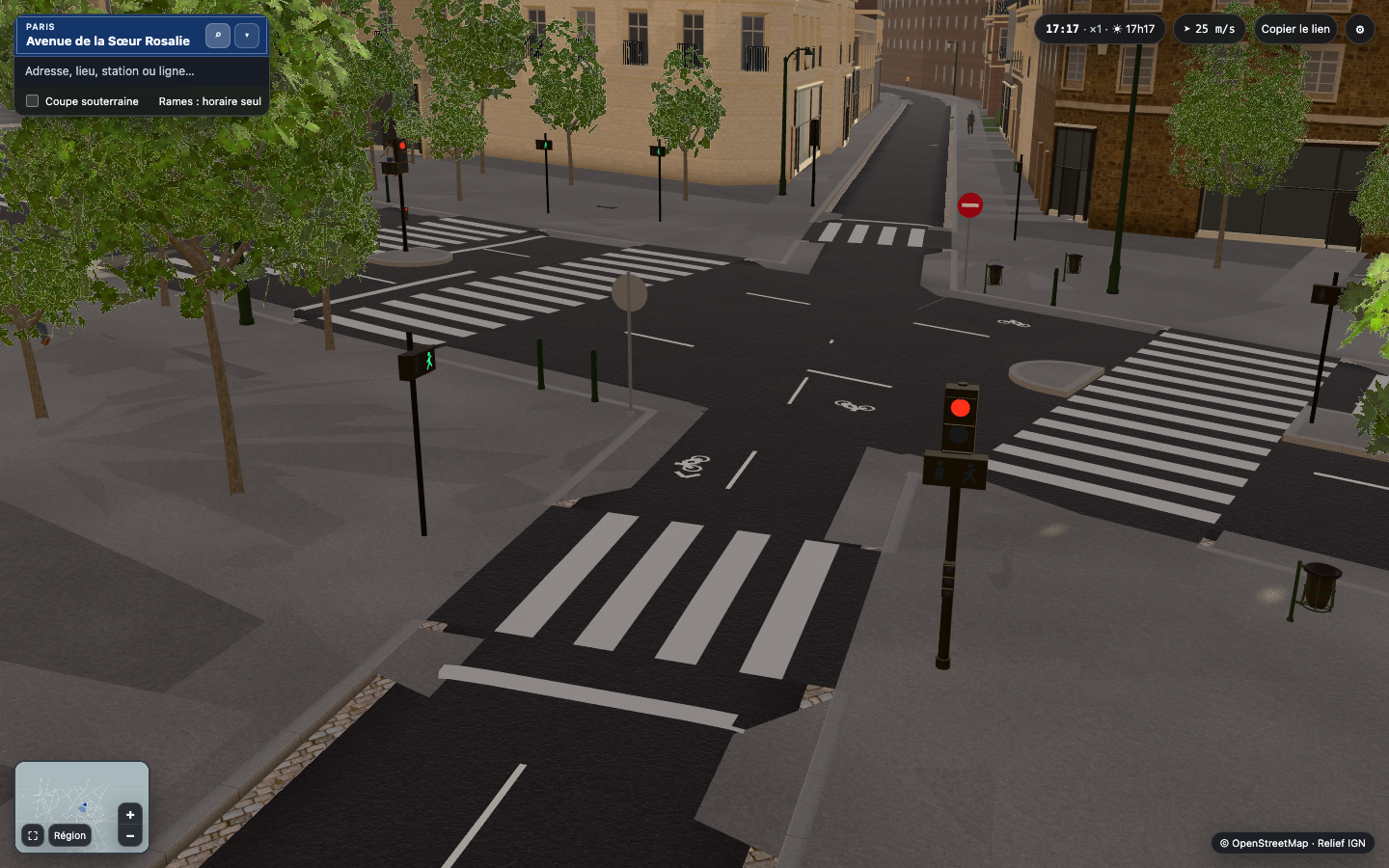
This city can be visited from an ordinary browser. The page stays under 496 MiB of video memory (VRAM), the memory the graphics card reserves for the image: I measured 486.88 MiB at the peak of a walk. And I still judge by the image. By comparing 1,577 km of Paris streets with open Panoramax photos, I counted 594 anomalies in the original terrain, and 180 fake bumps that my own processing had added.
That leaves the inhabitants' minds, which I can't hand over to a large language model twelve million times per instant. I am trying something else: an individual memory of 128 bytes, the space of 128 characters, less than a text message. The trial covers 44,853 inhabitants around the Contrescarpe. The first attempt turned into a farce: they went out to eat 3.62 times more often and dropped sport, down 70.1%. The next one moved me. When places to go out deteriorate, those who have this memory and pass the word on, in the family or among colleagues, turn away from them more: 10.25 points of attendance lost by the fourth week, against 7.17 without it.
This city is still missing a great deal. Household cars don't drive, and the ones you'll see parked are the only scenery I tolerate, for now. Real buses already run, but only in a pilot area. The 128-byte memory hasn't left its test neighbourhood. I would rather show you the holes than fill them with fakes.
The hour when the windows light up
Nothing in this engine is written for Paris. A municipality is the shared program plus its public data, and that is why the project is called Twinz: twins, plural. Paris and Île-de-France lead the way at paris.twinzcities.com. Other cities will follow, then other countries.
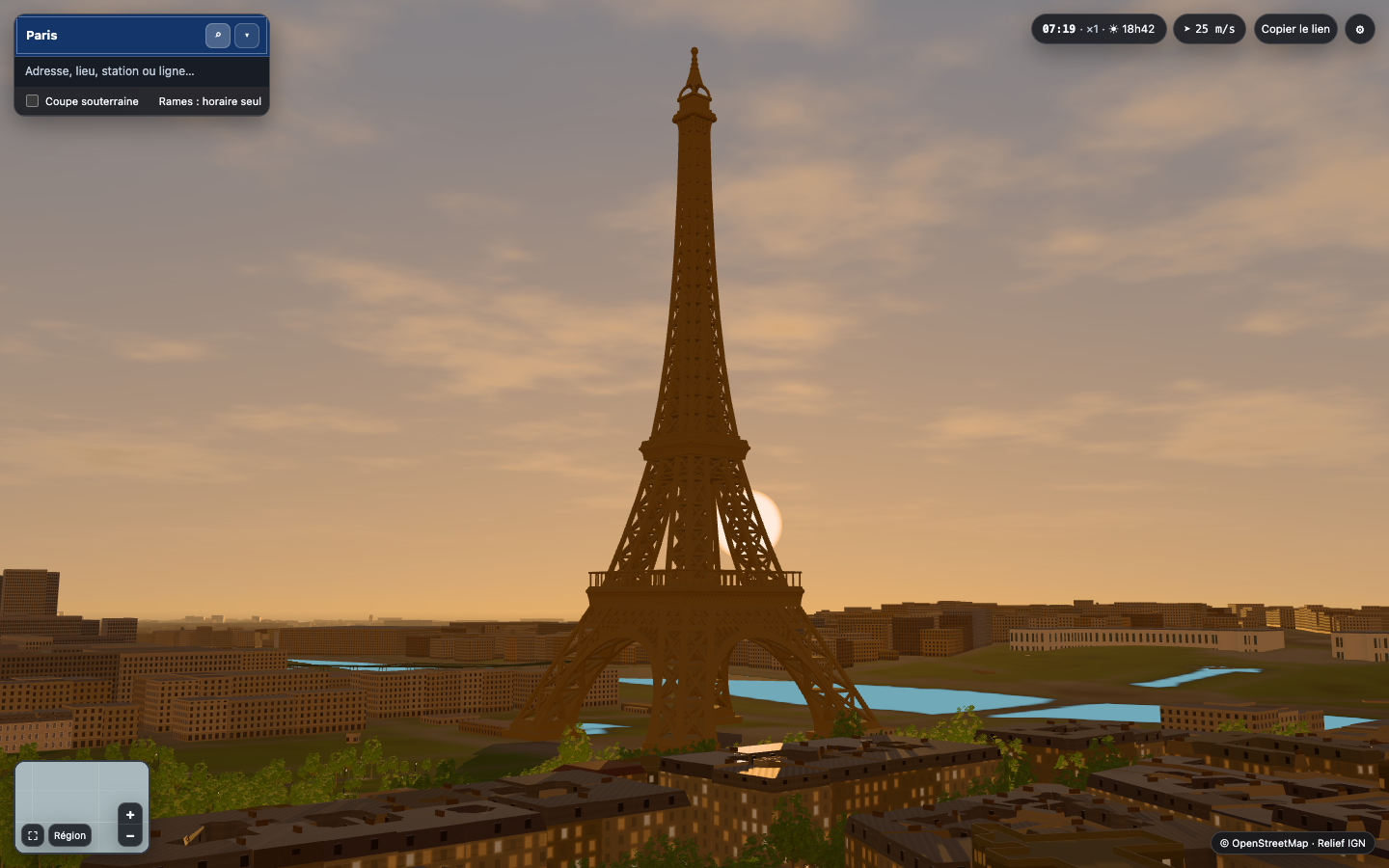
Now go back to the image at the top of this page. It is a capture from 25 November, unretouched. The sun is going down behind the Eiffel Tower, the sky has that apricot colour Paris treats itself to on certain evenings, and on the rooftops the first windows are lighting up. It is my favourite hour in the real Paris, when you walk with your head in the air and guess whole lives from a lamp, a curtain, a passing silhouette.
I stayed a long time in front of that sunset, and what tightened my throat was behind the walls. Under each of those roofs, in the computation, there are homes, and in those homes people whose day goes on. At the same second, someone is coming home from work in Montreuil and someone else, in Versailles, is counting what is left of their salary. Twelve million days move forward together, whether I watch them or not, and I now know they would be exactly the same if I switched off the screen.
In September, my little man reached the edge of the screen and ceased to exist. Today, a passer-by turns the street corner, and behind that corner there is the next street, then another, and at the end a building where he lives. What he will do tomorrow, nobody has written in advance, not even me.