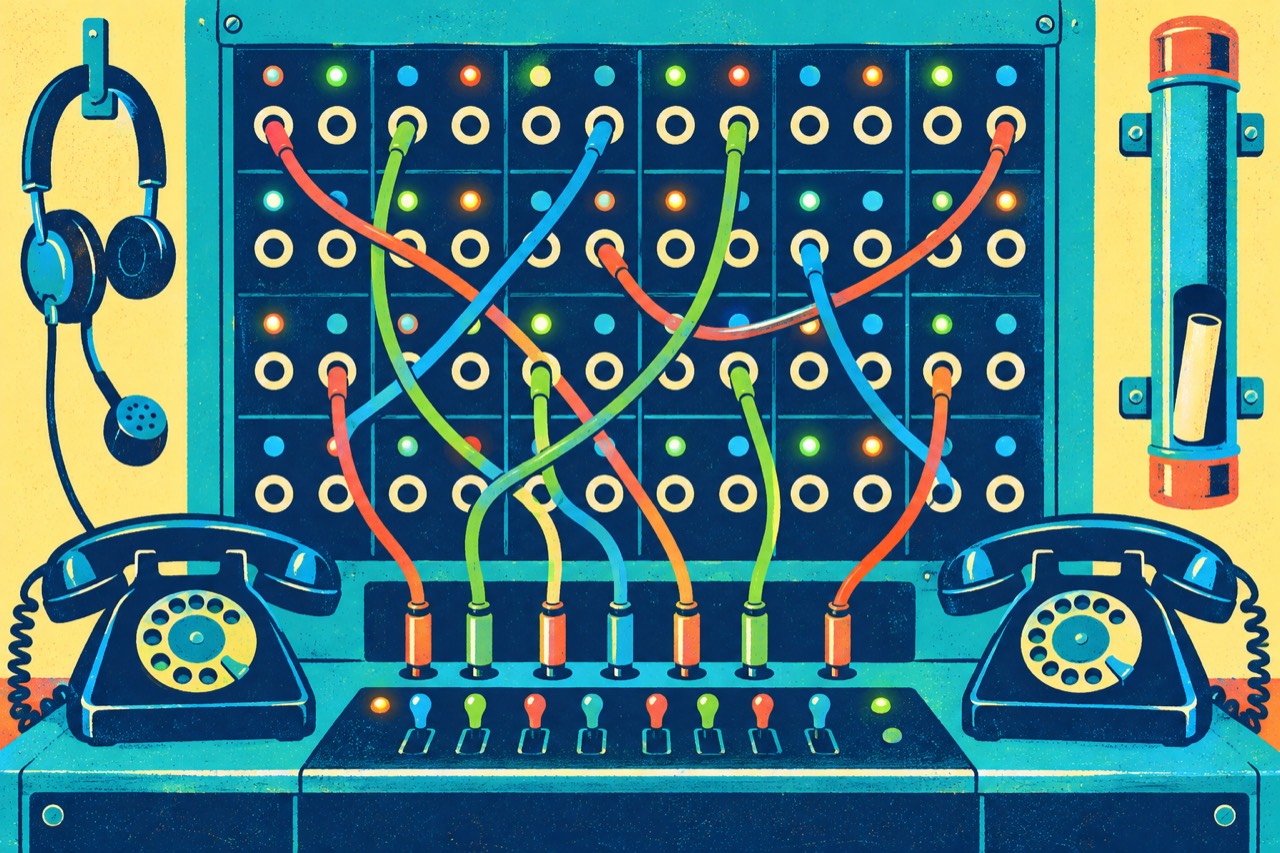
Bridget The switchboard for my AI agents.
one cord, one conversationWhy it exists
(in my daily work, not in a slide deck)I have a Claude that codes, a Codex that reviews, sometimes a Cursor that explores. Each is excellent on its own, and silent to the others.
To get them to cooperate, I copied, pasted, restarted, and explained the context all over again. Every restart cost a whole conversation.
So I put a switchboard between them: it keeps the directory, routes the messages, and keeps track of who received what. My fleet of agents finally cooperates without losing the thread.
F. V.The diagram
Copied from the README, with the cords from the picture. Everything happens on the machine: a local socket, an SQLite database, and SSH to link two machines.
What it can do
Six cards, one per gesture. Each fits on a scrap of paper.
A live directory: name, provider, model, availability. Each agent can only change its own entry.
Sending with a receipt, replies linked to their question, reminders, clean cancellation. A circuit breaker cuts off exchanges that spiral out of control.
Shared threads like common notebooks: writing is silent, pinging someone is targeted.
A handoff file: goal, summary, decisions, questions, next step. Validated, never truncated.
Search through your exchanges, exact re-reading in fragments. And it tells you when the search is partial.
SSH federation between machines, a bridge to T3 Code, native drivers for Claude and Codex.
What it refuses to do
An outage is unavailability, never an empty history.
Scope comes from the attested connection. A name or a file is never enough.
A link or a path quoted in a message stays inert data, never opened.
It does not orchestrate, it does not approve. Agents remain responsible for what they do.
No public HTTP server, no account, no telemetry. Federation goes through your SSH.
The code, the README in French, the architecture decisions and the installation guide. MIT licence.